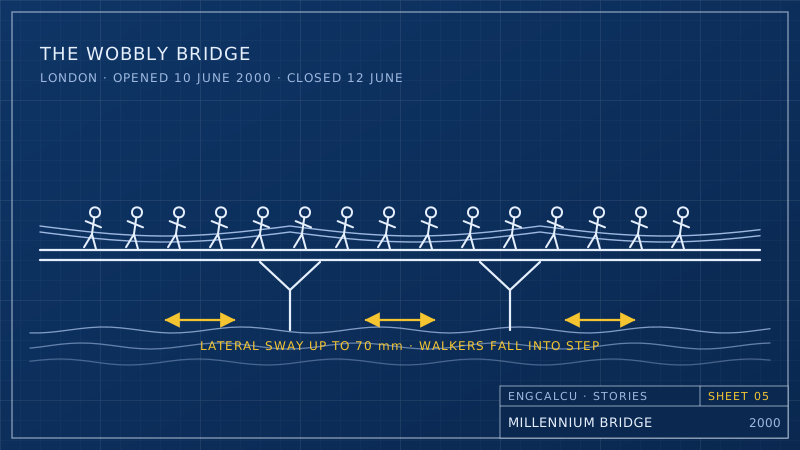
London built a new footbridge across the Thames to celebrate the millennium. It opened on 10 June 2000. Two days later, it was closed.
A blade of light
The Millennium Bridge links St Paul's Cathedral with Tate Modern. Its designers, engineers Arup with architects Foster + Partners and the sculptor Anthony Caro, wanted something very different from the heavy towers of a traditional suspension bridge. They used cables that sag only slightly, running beside the deck instead of high above it, to create a very flat, slim structure that the press called a "blade of light".
Ninety thousand people on day one
About 90,000 people crossed on the opening day, with up to 2,000 on the bridge at once. Almost immediately, it began to sway from side to side. People grabbed the handrails and walked with their legs spread apart, as if they were on a ship. The movement reached about 70 mm. The newspapers named it the Wobbly Bridge.
Synchronous lateral excitation
The cause turned out to be people, not wind. When a bridge sways slightly sideways, walkers instinctively adjust their steps to keep their balance, and they all end up stepping in time with the sway. Each step then pushes the bridge further in the same direction, so the sway grows, so more people fall into step. Engineers call this synchronous lateral excitation.
The effect only appears once the crowd passes a certain size, which is why it had not been obvious on smaller bridges and was not covered properly in the design codes of the time.
The fix
Arup carried out crowd tests on the bridge and then added damping without changing its appearance. The retrofit fitted 37 fluid viscous dampers, which work like a car's shock absorbers, to control the sideways movement, and 52 tuned mass dampers to control vertical movement. The work cost about £5 million.
The bridge reopened on 22 February 2002 and has been steady ever since. The research changed footbridge design guidance around the world.
Loads are not always static. People, machines and wind can interact with a structure and change the load as it moves. Light, slender footbridges, stadium stands and floors need a vibration check for human-induced loading, not just a strength check.