Some inventions come from years of careful planning. The microwave oven came from a sticky shirt pocket.
The engineer without a diploma
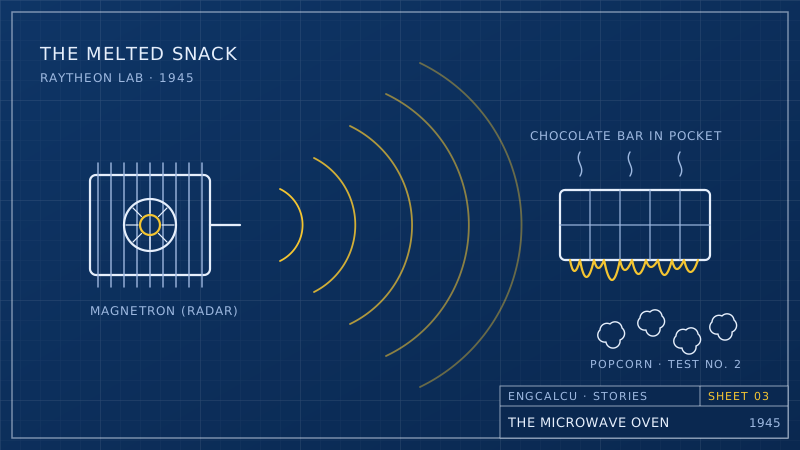
Percy Spencer left school young and taught himself electronics, partly while serving as a radio operator in the US Navy. By the Second World War he was one of the top engineers at Raytheon, a company building magnetrons, the vacuum tubes that generate the microwaves used in radar. Spencer found ways to mass-produce them, which helped Allied radar sets reach the front.
A snack goes soft
Around 1945, while standing near a working magnetron, Spencer noticed that the chocolate bar in his pocket had melted. Other engineers had felt warmth near radar equipment before, but Spencer was curious enough to test it properly.
He sent out for a bag of popcorn kernels and held them near the tube. They popped all over the lab. According to company lore, the next test was an egg, which exploded, reportedly in a colleague's face. The heating effect was real, fast and worth a patent.
The fridge-sized first model
Raytheon filed a patent in 1945 and launched the first commercial microwave oven, the Radarange, in 1947. It was nearly 1.8 metres tall, weighed around 340 kg and needed water cooling. It cost thousands of dollars, more than a new car, so the first buyers were restaurants, ship galleys and railway dining cars.
It took another two decades of engineering, smaller magnetrons, air cooling and cheaper manufacturing, before a countertop microwave became affordable for an ordinary kitchen in the late 1960s.
Why it heats food
Microwaves at about 2.45 GHz make water molecules in food rotate back and forth billions of times a second. That molecular friction turns into heat inside the food, rather than heating it from the surface inwards like a normal oven. It is the same physics that warmed Spencer's chocolate.
Unexpected results on site or in the lab are data, not noise. Spencer was not the first to notice the effect. He was the first to stop, test it and write it down. Keeping good site diaries and recording odd observations is how problems are caught early and new ideas are found.