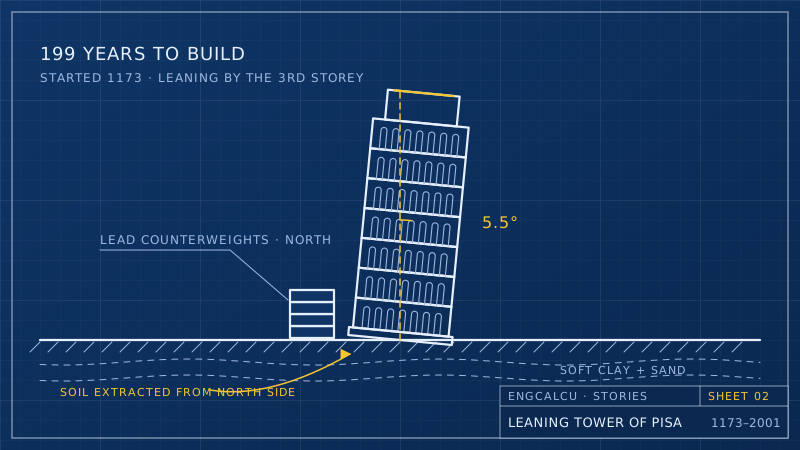
The most famous engineering mistake in Europe is also one of its biggest tourist attractions. Construction of the bell tower in Pisa began in 1173. By the time the builders reached the third storey, it had already started to lean.
A shallow foundation on soft ground
The tower sits on a foundation only about three metres deep, built on soft clay and sand left behind by ancient rivers. The ground under the south side was softer than under the north, so the south side settled more and the tower tipped towards it.
Any modern geotechnical engineer would have asked for a soil investigation first. In the 12th century, there was no such thing.
Saved by a war
Here the story takes a lucky turn. Pisa went to war with its neighbours, and construction stopped for almost a century. During that long pause, the clay under the tower slowly squeezed out water and became stronger. Engineers believe that if the builders had carried on without a break, the tower would have fallen over during construction.
When work restarted, the builders tried to correct the lean by making the upper storeys slightly taller on the lower side. The result is that the tower is not just tilted, it is very slightly curved, like a banana. The bell chamber at the top was finally completed in the 14th century, around 199 years after work began.
Leaning towards collapse
The lean kept growing for centuries. By 1990 it had reached about 5.5 degrees, and the top overhung the base by more than four metres. The tower was closed to visitors, and an international committee of engineers was formed to save it without straightening it completely, because a straight tower would no longer be the Leaning Tower.
The fix: take soil away, not add it
First, hundreds of tonnes of lead counterweights were stacked on the north side to stop the movement. Then the engineers used a counter-intuitive method called soil extraction. Using angled drills, they removed small amounts of soil from under the north side, a little at a time. As the ground there settled, the tower slowly rotated back.
The work, finished in 2001, reduced the lean by about 44 centimetres and returned the tower to roughly where it stood in the early 1800s. It reopened to the public in 2001, and monitoring shows it has kept straightening by a few more centimetres since.
Foundations fail slowly and quietly. Uneven settlement on variable soil is still one of the most common causes of cracking in buildings today. A proper soil investigation costs very little compared to 800 years of fixing the problem.